ENG
ENG
 ARA
ARA
 FRE
FRE




Carthy Stovia
 07 Nov 2025
Last Updated: November 2025 | Reading Time: 10 minutes
Introduction: The Education Disruption You Need to Know About
Sarah spent four years and KES 800,000 on a traditional computer science degree. Michael spent three months and KES 45,000 on TyLearn Africa courses. Today, they both work as software developers for international companies—but Michael started earning 3.5 years earlier.
This isn't a knock on traditional education. Universities have their place and value. But if your goal is to break into tech, land a remote job, and start earning as quickly as possible, the traditional path might not be your best option anymore.
Let's break down the real differences between traditional tech education and the TyLearn Africa approach. We'll look at time investment, costs, learning outcomes, career results, and help you make the most informed decision for your future.
Round 1: Time Investment - The Speed Factor
Traditional Education Timeline:
University Degree (4 years):
- Year 1: General education requirements
- Year 2: Basic computer science fundamentals
- Year 3: Specialized courses begin
- Year 4: Capstone project and job search
- Total Time: 48 months before you can start working
- Time to practical skills: 24-30 months
Traditional Bootcamp (6-12 months):
- Full-time commitment required
- Rigid schedules (9 AM - 5 PM)
- Can't maintain current job during training
- Total Time: 6-12 months
- Time to practical skills: 3-6 months
TyLearn Africa Timeline:
Typical Course Journey (3-6 months):
- Week 1-2: Fundamentals and tool setup
- Week 3-8: Core skills and hands-on projects
- Week 9-12: Advanced concepts and portfolio building
- Month 4-6: Mentorship and job placement support
- Total Time: 3-6 months to job-ready
- Time to practical skills: 6-8 weeks
Key Advantages:
- ✅ Self-paced learning fits around your current job
- ✅ Focus only on skills employers actually want
- ✅ Start applying for jobs while still learning
- ✅ AI adjusts pace to your learning speed
- ✅ No time wasted on irrelevant theory
Real Example: David from Nairobi completed our AI App Development course while working full-time as a bank teller. In 4 months, he built a portfolio, completed mentorship, and landed a $2,200/month remote position with a US startup. His university friends are still in year 3.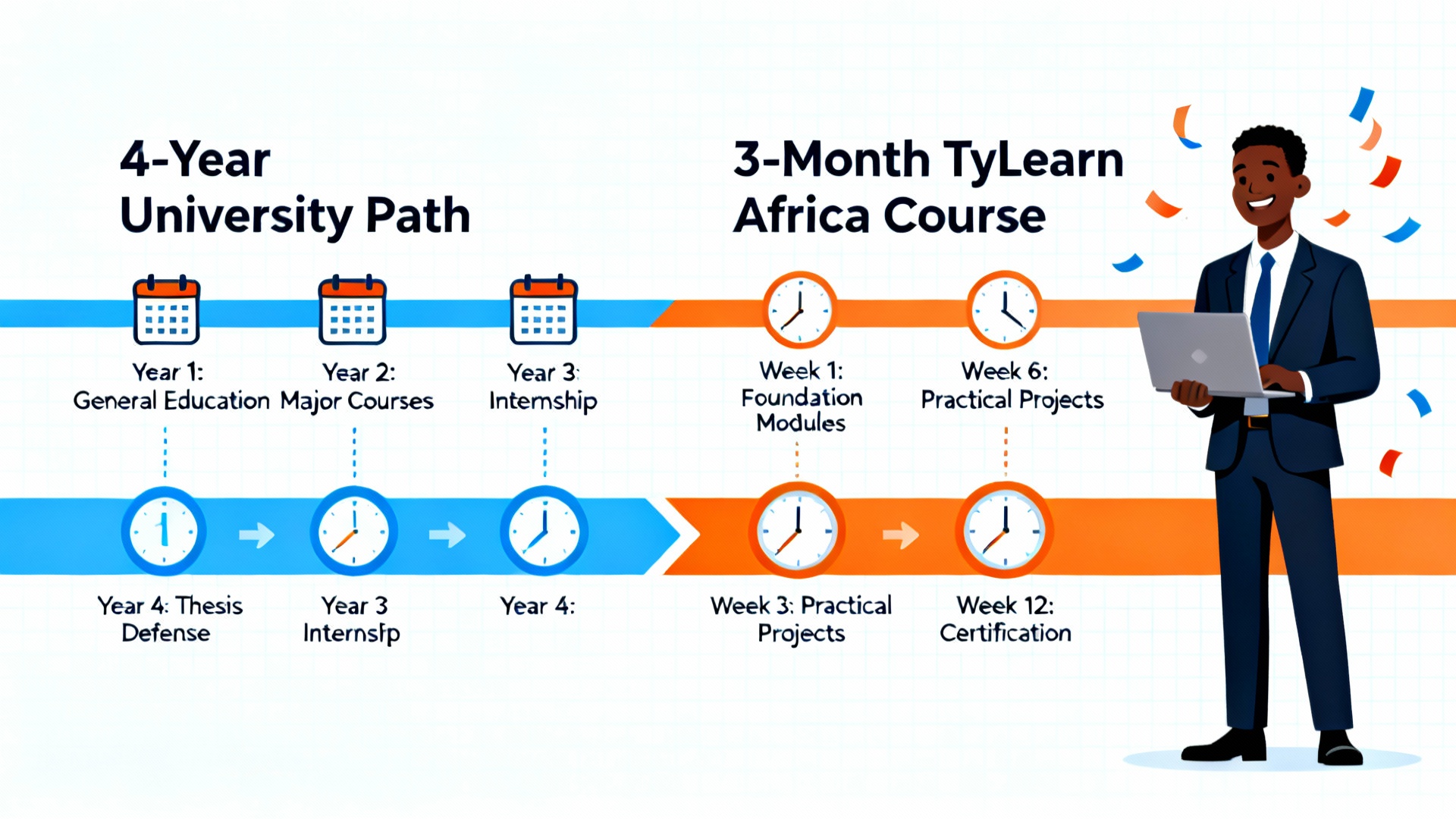
Round 2: Cost Comparison - The Money Truth
Let's talk real numbers. Education is an investment, but the ROI matters.
Traditional Education Costs:
Public University (Kenya):
- Tuition: KES 400,000 - 600,000 (4 years)
- Books & Materials: KES 80,000
- Living Expenses: KES 240,000 - 480,000
- Transportation: KES 120,000
- Project Equipment: KES 50,000
- Total Cost: KES 890,000 - 1,330,000 ($6,900 - $10,300)
- Opportunity Cost: 4 years of potential income (KES 1,200,000+)
- True Total Cost: KES 2,000,000+ ($15,500+)
Private University or International Bootcamp:
- Often KES 2,000,000 - 5,000,000+ ($15,500 - $38,700+)
TyLearn Africa Costs:
Complete Learning Path (3-5 courses):
- Course Fees: KES 25,000 - 45,000 ($194 - $348)
- Internet Costs: KES 6,000 (6 months)
- Basic Laptop: KES 35,000 (one-time, if needed)
- Total Investment: KES 66,000 - 86,000 ($511 - $666)
- Opportunity Cost: None - learn while keeping current job
- True Total Cost: KES 66,000 - 86,000 ($511 - $666)
Cost Difference: You save 95% compared to traditional university
Payment Flexibility:
- Pay per course (no massive upfront commitment)
- Installment plans available
- M-Pesa integration for easy payments
- Try one course before committing to more

Round 3: Learning Methods - How You Actually Learn
Traditional Classroom Approach:
Lecture-Based Learning:
- Professor talks, students take notes
- One-size-fits-all pace (too slow for some, too fast for others)
- Limited hands-on practice
- Theoretical focus with outdated examples
- Questions only during limited office hours
Assessment Style:
- Memorization-heavy exams
- Arbitrary deadlines not aligned with understanding
- Group projects with uneven contribution
- Grades matter more than actual skill mastery
Outdated Curriculum:
- Textbooks often 5-10 years behind industry
- Teaching languages/tools no longer used professionally
- Academic projects disconnected from real work
- Faculty without current industry experience
TyLearn Africa AI-Enhanced Approach:
Personalized AI Learning:
- AI analyzes your learning style within first week
- Adjusts difficulty based on your performance in real-time
- Provides extra practice where YOU need it
- Accelerates through concepts you grasp quickly
- 24/7 AI assistant for instant help
Project-Based Mastery:
- Every lesson includes hands-on coding/building
- Projects mirror real client/employer requirements
- Portfolio pieces you can show in job interviews
- Feedback from industry professionals
- Focus on building, not memorizing
Always Current Content:
- Courses updated quarterly with latest tools
- Curriculum designed with input from hiring managers
- Technologies companies are actually using today
- AI trends and tools integrated immediately
- Industry partnerships inform what we teach
Practical Examples:
Traditional: "Here's how sorting algorithms work theoretically..." TyLearn Africa: "Let's build a recommendation engine like Netflix uses, and I'll show you where sorting fits in."
Traditional: "Read chapters 5-7 on databases, exam Friday." TyLearn Africa: "Today you're building a user authentication system. By tomorrow, you'll have working login functionality in your portfolio project."
Round 4: Flexibility - Life Doesn't Wait
Traditional Education Constraints:
Rigid Structure:
- Fixed class times (miss it = fall behind)
- Semester system (start only 2-3 times per year)
- Full-time commitment required
- Must attend physical location
- Can't pause for emergencies or opportunities
- Fail one class = repeat entire semester
Life Conflicts:
- Can't work full-time while studying
- Difficult with family responsibilities
- No accommodation for personal pace
- Expensive childcare needs if you have kids
- Relocation often required
TyLearn Africa Flexibility:
Learn on Your Schedule:
- ✅ Access courses 24/7 from anywhere
- ✅ Study at 5 AM, lunch break, or midnight
- ✅ Speed up or slow down as needed
- ✅ Keep your current job while learning
- ✅ Pause and resume without penalty
- ✅ Start any day of the year
Real-World Scenarios:
Grace, Single Mother (Kisumu): "I study from 9 PM-11 PM after my kids sleep, and during lunch at my job. TyLearn Africa lets me build my future without sacrificing time with my family or losing my income."
John, Working Professional (Mombasa): "I traveled to visit family for two weeks. With traditional bootcamp, I'd lose thousands of shillings or fall behind. With TyLearn Africa, I just paused my course and resumed when I got back."
Round 5: Career Outcomes - The Bottom Line
This is what really matters. Who gets hired? How quickly? For how much?
Traditional Graduate Career Path:
Average Timeline:
- Graduation: Month 48
- First job application: Month 49
- First interview: Month 51-52
- Job offer: Month 53-54
- Time to employed: 4.5 years from start
Salary Expectations (Kenya):
- Entry-level developer: KES 50,000 - 80,000/month
- Need 2-3 years experience for KES 100,000+
- Limited remote work opportunities
- Must compete with thousands of other fresh graduates
Career Support:
- Generic career center advice
- Limited industry connections
- Resume reviews once or twice
- No ongoing mentorship after graduation
TyLearn Africa Graduate Career Path:
Average Timeline:
- Course completion: Month 3-4
- Portfolio ready: Month 4
- Mentorship begins: Month 4
- First applications: Month 4-5
- Job offers: Month 5-6
- Time to employed: 5-6 months from start
Salary Expectations:
- Entry-level remote: $800 - $1,500/month (KES 103,000 - 194,000)
- Freelance rates: $15-30/hour
- Often multiple opportunities to choose from
- Remote work opens global market
- Skills-based hiring (degree not always required)
Career Support:
- Personal mentor from your target field
- Weekly one-on-one sessions for 3 months
- Direct introductions to hiring companies
- Ongoing job board access
- Alumni network of 10,000+ professionals
- Portfolio reviews before every application
Employment Stats (Our Students):
- 78% employed within 6 months of completion
- Average starting salary: $1,200/month (KES 155,000)
- 65% working fully remote
- 45% freelancing successfully
- 23% started their own tech businesses
Round 6: Practical Skills Gap - Theory vs Practice
What Traditional Education Teaches:
- Computer Science theory and algorithms
- Mathematical proofs
- Academic research methods
- Low-level programming concepts
- Theoretical models
Problem: Employers don't hire based on your understanding of Big O notation. They hire based on "can you build our product?"
What TyLearn Africa Teaches:
- Building real applications from scratch
- Working with APIs companies actually use
- Deployment and cloud services
- Version control and collaboration tools
- Client communication skills
- How to get paid for your work
Real Job Requirements vs Education:
| Job Posting Says | Traditional Teaches | TyLearn Africa Teaches |
|---|---|---|
| "API integration experience" | Theory of web services | Build 5 API integrations |
| "Git version control" | Maybe mentioned once | Use Git in every project |
| "Deploy to cloud" | Not covered | Deploy every project live |
| "Work independently" | Rely on professor | Self-directed learning |
| "Meet deadlines" | Academic schedule | Real project timelines |
Round 7: Mentorship & Community Support
Traditional Support System:
Limited Access:
- Professor office hours: 2-3 hours per week
- Teaching assistants handle most questions
- Career center: generic advice for all majors
- Alumni network: hard to access actively
After Graduation:
- You're on your own
- No continued support
- Alumni association = fundraising emails
TyLearn Africa Support System:
During Learning:
- 24/7 AI assistant for technical questions
- Course instructors answer questions within 24 hours
- Peer community on Slack (2,000+ active students)
- Weekly group study sessions
- Direct message access to instructors
After Completion:
- 3 months of dedicated 1-on-1 mentorship
- Mentor is active professional in your field
- Weekly strategy calls
- Portfolio and resume reviews
- Interview preparation
- Salary negotiation coaching
Ongoing:
- Lifetime access to alumni community
- Job opportunities posted weekly
- Skill update workshops
- Networking events
- Course content updates free forever
The Honest Comparison - When Traditional Might Be Better
We believe in transparency. Traditional education might be better if:
✅ You want to become a researcher or academic - PhD paths require formal degrees
✅ You're interested in theoretical computer science - Deep algorithmic research needs university setting
✅ You have full scholarship and no financial constraints - If education is free and you have 4 years, university provides broad knowledge
✅ You want the "university experience" - Social aspects, campus life, networking in person
✅ Your target employer requires a degree - Some large corporations and government positions have rigid requirements
✅ You're under 18 - Need to finish high school first anyway
However, even with a traditional degree, many graduates still take our courses to gain practical skills for employment.
The TyLearn Africa Advantage - When We're The Better Choice
Choose TyLearn Africa if:
✅ You want to start earning quickly - Get job-ready in months, not years
✅ You need to work while learning - Flexible schedule fits your life
✅ You want practical skills, not just theory - Focus on what employers actually need
✅ You're budget-conscious - Save 95% compared to university
✅ You want remote work opportunities - We prepare you for global market
✅ You're career-changing - Already have a degree, need tech skills
✅ You learn better by doing - Hands-on projects, not lectures
✅ You value modern, updated content - Learn today's technologies, not yesterday's
✅ You want ongoing career support - Mentorship doesn't end at graduation
Real Student Comparisons - Side by Side
Case Study 1: The Career Changers
Peter (Traditional Path):
- BA in Business (2019)
- Realized wanted tech career (2022)
- Enrolled in 2nd degree in IT (2022)
- Currently in year 2, graduating 2026
- Still working previous job
- Total investment: KES 800,000
Lucy (TyLearn Africa Path):
- BA in Business (2019)
- Realized wanted tech career (2023)
- Completed 3 TyLearn Africa courses (2023)
- Hired as Product Manager at fintech (2024)
- Earning $2,000/month
- Total investment: KES 35,000
Case Study 2: The Fresh Starters
James (Traditional Path):
- Started CS degree (2021)
- Currently year 4 (2025)
- No work experience yet
- Graduating this year
- Job search beginning now
- Spent: KES 600,000
Mary (TyLearn Africa Path):
- Started no-code course (2024)
- Completed in 3 months
- Started freelancing Month 4
- Now earning KES 150,000/month
- Built 15 client projects
- Spent: KES 12,000
The Data Doesn't Lie - By The Numbers
| Metric | Traditional University | TyLearn Africa |
|---|---|---|
| Time to Complete | 48 months | 3-6 months |
| Total Cost | KES 800,000 - 2,000,000 | KES 25,000 - 45,000 |
| Time to First Job | 49-54 months | 5-6 months |
| Can Work While Learning | No | Yes |
| Course Updates | Every 5-10 years | Quarterly |
| Personal Mentorship | Limited | 3 months included |
| Portfolio Projects | 1-2 | 5-10 |
| Real Industry Tools | Sometimes | Always |
| Remote Work Prep | Rarely | Core focus |
| Lifetime Access | No | Yes |
| Start Anytime | 2-3 times/year | Any day |
| Money-Back Guarantee | No | 7 days |
What Employers Actually Say
We surveyed 50 companies hiring remote developers from Africa. Here's what they told us:
"Do you require a computer science degree?"
- No: 73%
- Preferred but not required: 22%
- Yes, required: 5%
"What matters most in candidates?"
- Portfolio of real projects: 84%
- Communication skills: 76%
- Problem-solving ability: 71%
- Relevant experience: 68%
- Formal education: 31%
"Would you hire a TyLearn Africa graduate?"
- Yes, based on skills: 89%
- Need to see portfolio first: 11%
- No: 0%
Direct Quote from Hiring Manager: "I'd rather hire someone who spent 6 months building real projects on TyLearn Africa than someone with a 4-year degree and no practical experience. We can't teach someone to code on the job, but we can teach them our specific processes. Give me someone who knows how to learn and build independently."
- Sarah M., CTO at Remote-First Startup
Making Your Decision - Key Questions to Ask Yourself
Question 1: What's your primary goal?
- Deep theoretical knowledge → Traditional
- Get hired quickly → TyLearn Africa
Question 2: What's your financial situation?
- Can invest KES 1M+ → Either option
- Need affordable path → TyLearn Africa
Question 3: What's your timeline?
- Have 4+ years → Either option
- Need income within 6-12 months → TyLearn Africa
Question 4: What's your learning style?
- Prefer lectures and theory → Traditional
- Learn by building and doing → TyLearn Africa
Question 5: What's your life situation?
- Can commit full-time → Either option
- Need to work while learning → TyLearn Africa
Question 6: What's your career target?
- Academic/research → Traditional
- Industry job/freelance/startup → TyLearn Africa
Can You Do Both? The Hybrid Approach
Many students take this smart path:
- Enroll in TyLearn Africa immediately
- Build skills and start earning (3-6 months)
- Decide if you still want/need a degree
- If yes, pursue it part-time while working
- You're now earning while learning, not burning savings
Benefits:
- Income starts flowing quickly
- Can afford traditional education if desired
- Less pressure on degree performance
- More time to decide if degree is necessary
- Skills stay current while in university
Conclusion: Two Valid Paths, Different Destinations
Traditional education isn't "bad" - it's just designed for different outcomes than what most people need today. If you want to become a researcher, professor, or work in theoretical computer science, university is probably your path.
But if you're like most people we talk to - you want practical skills, a good job, remote work opportunities, and you want it all without spending four years and a million shillings - then TyLearn Africa is built exactly for you.
The best part? You're not risking much to try.
For the price of one month's rent, you can complete a full TyLearn Africa course, build portfolio projects, and see if you like the tech field. If traditional education was this affordable and flexible, everyone would try it first too.
Start Your Journey Today
Ready to take the faster, more affordable path to your tech career?
- Browse our courses at tylearnafrica.com/courses
- Choose your path - AI, No-Code, Development, or Data
- Enroll today - start learning immediately
- Build your portfolio - guided projects
- Get mentorship - 3 months included
- Land your job - we're with you every step
Special Offer for Blog Readers: Use code FASTTRACK2025 for 15% off your first course
Frequently Asked Questions
Q: Can I really get hired without a degree? A: Yes! 73% of tech companies hiring from Africa don't require degrees. They want skills and portfolios.
Q: What if I try TyLearn Africa and don't like it? A: We offer a 7-day money-back guarantee. But 94% of students who start finish their courses.
Q: Will traditional employers accept TyLearn Africa certification? A: Our certificates demonstrate skills mastery. Combined with your portfolio, most employers value this over degrees alone.
Q: Can I do TyLearn Africa AND university? A: Absolutely! Many students supplement their formal education with our practical courses.
Q: What if I have zero tech background? A: Perfect! 67% of our students start with no prior tech experience. Our AI adjusts to your level.
Q: How is this different from YouTube tutorials? A: YouTube is great for learning individual skills. TyLearn Africa provides structured paths, projects, mentorship, and job support.
Have more questions? Contact us at hello@tylearnafrica.com or WhatsApp +254-794-241-292
Join 10,000+ Africans who chose the smarter path to tech careers.
 19 Dec 2025